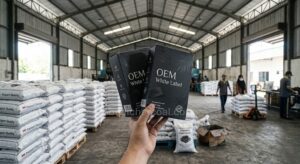

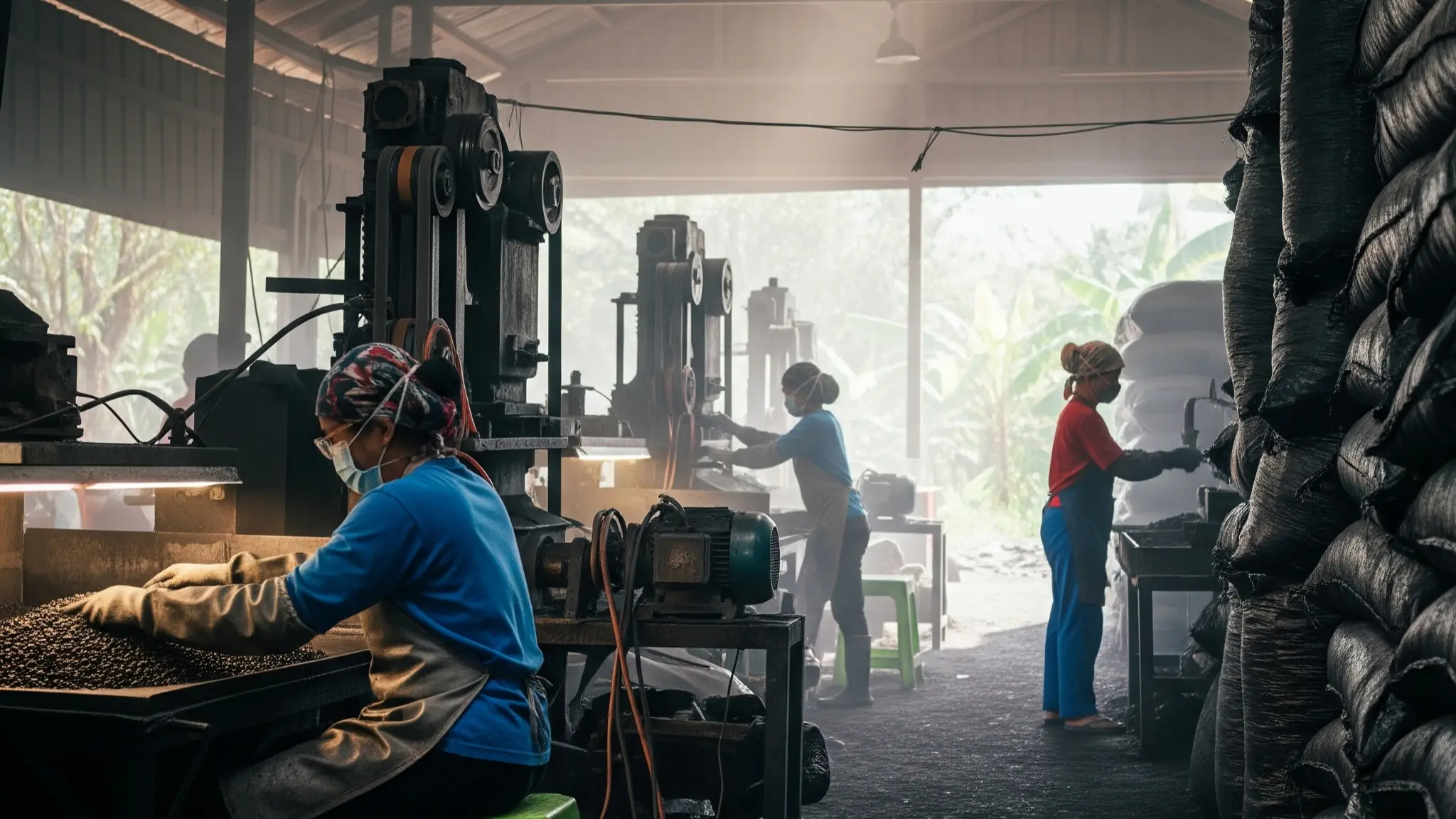
ABADICHARCOAL.com – The journey of a perfect shisha cube is one of precision, heat, and pressure. What starts as a humble coconut shell transforms into a dense, long-lasting briquette through a multi-stage process. Understanding this journey gives you a deeper appreciation for the product and helps you identify a quality-focused supplier. Let’s take a tour inside a typical of Indonesia coconut charcoal briquettes factory in Indonesia to see how it’s done.
Carbonization of Coconut Shells
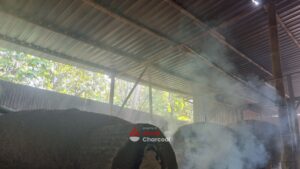
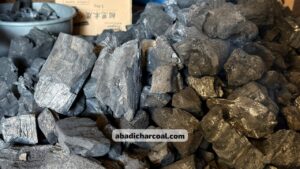
It all begins with the raw material: aged coconut shells. These shells are not burned in an open fire but are carbonized in a kiln with limited oxygen. This process, known as pyrolysis, burns off moisture and volatile matter, leaving behind pure carbon, or charcoal. The quality of this initial step is crucial. A well-run coconut charcoal briquettes factory will use high-grade, fully carbonized shells to ensure the final product has low ash and high heat.
Crushing and Sieving
Once the shells have been turned into charcoal, they are crushed into a coarse powder. This powder is then run through a sieving or screening machine. This step is vital for achieving a uniform particle size. A factory dedicated to quality will use fine mesh screens to get a consistent, flour-like powder. This uniformity ensures that the briquettes bind together perfectly and burn evenly, a key feature buyers expect from a top-tier Indonesia coconut charcoal briquettes factory.
Mixing with a Natural Binder
The fine charcoal powder cannot form a briquette on its own. It needs a binder to hold it together. A reputable factory will use only natural, food-grade binders, most commonly tapioca starch. The charcoal powder and tapioca starch are mixed with water in a large industrial mixer. The ratio of charcoal to binder is a closely guarded secret at every coconut charcoal briquettes factory, as it directly impacts the briquette’s hardness, ash content, and smell. No chemical binders should ever be used.
Briquetting (Extrusion and Cutting)
This is where the magic happens. The mixed paste is fed into a briquetting machine. The machine uses immense pressure to extrude the paste into a specific shape—often a long, square log. As the log comes out, an automated cutter slices it into the desired cube size (e.g., 25mm or 26mm). The pressure applied during this stage is critical for the briquette’s density and, consequently, its burning time. A high-pressure machine in a good coconut charcoal briquettes factory produces hard, durable cubes that won’t crumble easily.
Drying and Curing in the Oven
The freshly cut briquettes are wet and soft. They must be dried thoroughly to become hard and usable. The briquettes are carefully placed on trays and moved into a large oven for a long drying period, which can last for 24 hours or more. This process removes all remaining moisture, bringing the level down to the target specification (usually below 6%). This final step is essential; improperly dried briquettes will produce sparks and have a shorter burn time. A professional Indonesia coconut charcoal briquettes factory invests in proper ovens to guarantee a perfectly cured, premium product.